   Assault on the Spider Necromancer's Lair is compatible with all RPG systems!   These backstories are compatible with all RPG systems!  |
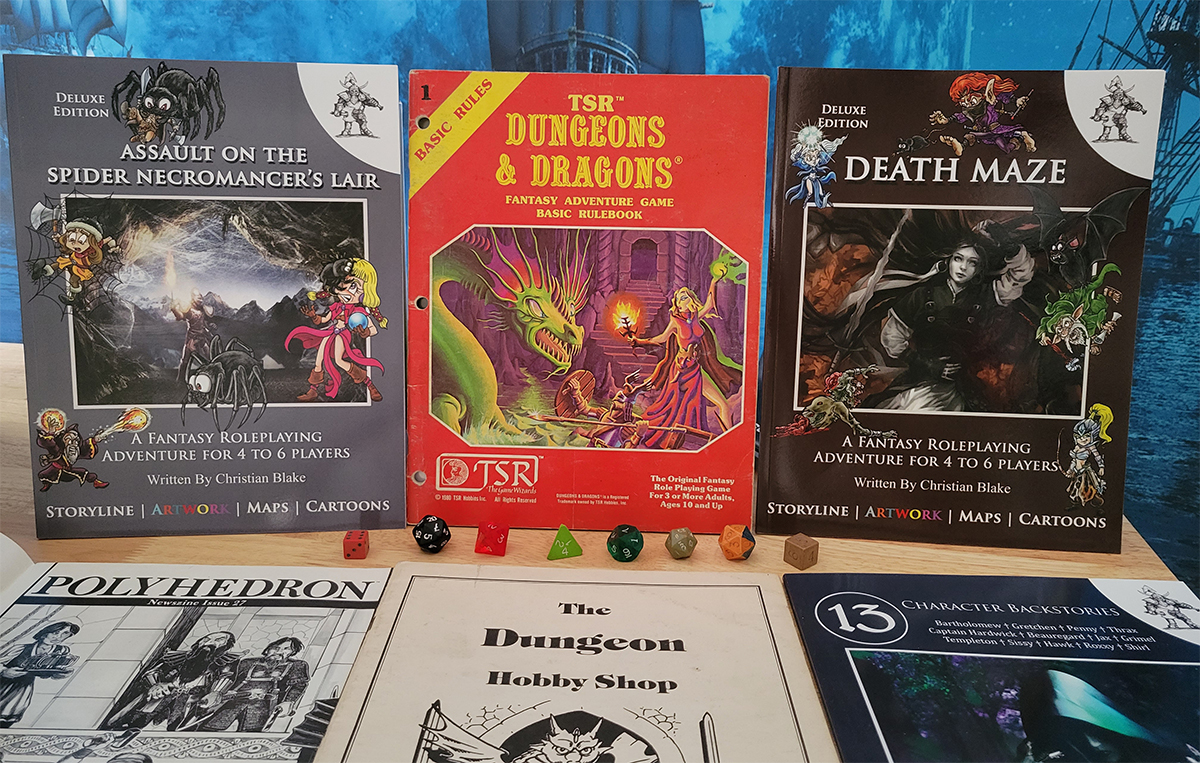
Dungeons and Dragons Fantasy Adventure Game Basic Rulebook
8.5” x 11” paperback, 64 pages
Edition reviewed: First printing, January 1981
As the title suggests, this paperback focuses on the basic rules of Dungeons & Dragons. The book is broken down into eight sections:
Introduction
Player Character Information
Spells
The Adventure
The Encounter
Monsters
Treasure
Dungeon Master Information
Part 1: Introduction
The basic set focuses on playing characters within a dungeon setting ranging from level 1 thru level 3. If players wish to earn experience beyond level 3, they will need to read the Expert Rules which explains player levels from 4th to 14th level of experience. And for players who want to go higher than 14th level, the D&D Companion Set is recommended for details relating to player classes from the 15th level all the way up to the 36th level.
At one time, I probably had the D&D Companion Set but apparently I don’t any longer (unless it’s buried in a box somewhere in one of my storage units). I do have the Expert Rules which I will review on another page.
Anyway, on with my review of the Basic Rules!
Clearly stated on the third page of the book is that these “basic rules” are nothing more than guidelines for playing the game. If the referee (Dungeon Master) determines that a rule can be discarded, then it should be discarded. The book makes it very clear that the DM is without question the final authority on a game session (as it should be).
There is actually a section which describes game terms. I suppose this is helpful to the absolute beginner player:
Dungeon Master – the person who prepares the adventure and referees the game
Players – the person or persons who play the roles of “player characters” (PCs)
Non-player characters – these are characters controlled by DM (NPCs)
Party – any group of players accompanied by NPCs forms a “party”
Dungeon – any underground setting prepared by the DM that is formed by caverns,
tunnels or stone rooms
Dungeon Module – a pre-designed setting to be used by the DM
Adventure – a game session that begins when the players first enter a dungeon and ends when they finally exit the dungeon and divide their treasure.
Campaign – a multi-game session that combines multiple, intertwined adventures often
using the same player characters (PCs) and non-player characters (NPCs)
Mapper – As the party moves throughout the dungeon, the DM will describe what they
see. The player who draws a map based on the DM’s description is called the
“mapper”. Caller – the player who informs the DM of the decisions made by the party
Monster – any “animal, person or supernatural creature” that is not a player character
Encounter – when player characters come face-to-face with monsters
Melee – when player characters and monsters combat each other
Experience Points – also referred to as “XP”, this is a numbered value that is earned
through gameplay. Earn enough XP and a player character will transition from
“Level 1” to “Level 2” and so on.
The definition of “Level” is given multiple descriptions:
Character Experience Level: referring to the experience level of a character, such as a
“Level 3 Fighter” or a “Level 2 Thief”
Monster Level: used as a basic description of a monster’s toughness, such as simply
stating a “Level 8 Monster” approaches your party. That conveys a lot of
information especially when the party makeup is made primarily of “Level 1”
characters.
Spell Level: used to determine spell-casting difficulty; the higher the level, the more
difficult it is to cast and (usually) the more powerful the spell’s effects
Dungeon Level: used to describe which level the adventure is taking place. Typically, the 1st of the dungeon is called “the first level” and each level downward represents a more difficult adventure for the players.
Part 2: Player Character Information
This section of the book breaks down character creation is an easy to follow process which is summarized at the end of the section:
- Roll for ability scores
- Choose a class
- Adjust scores
- Roll hit points
- Roll for money and equip your character
- Establish armor class as well as “to hit” numbers and saving throw numbers
- Give your character a name
Each ability score is explained in detail, and a chart explains bonuses and penalties attributed to the player character as a result of the ability score.
Creating a character is rather simply explained and easy enough for anyone to follow.
The next section describes the individual Character Classes:
Clerics
Dwarves
Elves
Fighters
Halflings
Magic-Users
Thieves
Alignment is described in the next section of the book. Detailed descriptions are provided for Law, Chaos and Neutrality. Each type of alignment has a secret language that includes passwords, hand signals and other body motions. When a player chooses a type of alignment for their player character, the character is expected to live up to its stated alignment.
There are 20 known languages in the Basic Edition: Bugbear, Doppleganger, Dragon, Dwarvish, Elvish, Gargoyle, Gnoll, Gnome, Goblin, Halfling, Harpy, Hobgoblin, Kobold, Lizard Man, Medusa, Minotaur, Ogre, Orc, Pixie and Human Dialect.
“Hopeless Characters” are described as characters with multiple scores ranging from 3 to 6. The DM, at his discretion, may label such as a character as unfit for dangerous adventures and allow the player to roll a new character.
The book then provides a rather detailed step-by-step example of creating a character.
Part 3: Spells
The next section describes Spells and includes 38 total spells for use by level 1, 2 and 3 characters. Spell use and their descriptions are explained in detail.
Part 4: The Adventure
The next section describes the Adventure and goes into detail of party composition, movement speed, rest and encumbrance. The encumbrance section is rather interesting. All items are measured in “coin weight”. Each character totals up their respective gear weight based on coin weight. Using that final number of coin weight, a players movement speed is established.
Light is discussed next (as in, “who’s holding the torch?”) and so are doors, secret doors and eavesdropping through a closed door in an attempt to ascertain what or who is on the other side.
Traps, wandering monsters and rewarding experience points are discussed next. Experience point values are directly related to a monster’s hit dice and special abilities (if any).
Part 5: The Encounter
An order of events for each game turn is shown as an example:
- Roll for wandering monsters
- Party movement
- The turn ends unless monsters are encountered (go to step 4)
- The DM establishes distance from the wandering monsters and the party
- The DM rolls a 1d6 to determine whether the monsters or the party gets the element of surprise
- Initiative is rolled for next with the DM representing the monsters
- The DM rolls 2d6 for the monster’s reaction
- The party and monsters react to each other (talk, run or fight)
- End of turn
Each section of the above game-turn sample is then described in detail.
Combat is the next section discussed within the book and includes the following topics:
Defensive Movement
How to Attack
Missile Fire
Melee
Damage
Saving Throws
Morale
A rather lengthy section comes next, and it describes a typical combat situation from start to finish.
Part 6: Monsters
The next section of the book discusses Monsters, their Armor Class, their Hit Dice, Movement and their Attacks. There are over 100 monsters including sub-types of some monsters (such as five different types of Lycanthropes).
Part 7: Treasure
The next section of the book discusses the different types of treasure from coins (copper, silver, electron, gold, platinum) to jewelry and magic items. There is a nice table that allows for random rolling to determine treasure that allows for the chance of jewelry and/or magic items.
Magic items are then discussed in detail as are scrolls, rings, staves, wands and rods. In addition to the basic possibilities of magic items, there is a list of named magic items and their effects.
Part 8: Dungeon Master Information
The final section of the book provides help for the Dungeon Master. In this section the DM will find a step-by-step process for preparing the dungeon adventure, stocking it with monsters and traps and treasure, and possibly adding non-player characters should the DM wish to include one or more. Three charts are also included for Wandering Monsters (Level 1, Level 2 and Level 3).
Next is a sample dungeon included called the Haunted Keep. It’s a fully stocked, ten-room dungeon that includes a simple map. After the Haunted Keep’s description is a Sample Dungeon Expedition that describes the play-by-play interaction between DM and the players. This play-by-play sample is an excellent example of what DM’s can expect to deal with when managing a game.
If you are a D&D collector, I think this is an important book to have. Although it’s not quite the beginning of Dungeons and Dragons, it’s probably the closest you’ll get to owning a publication related to the beginning of TSR’s Dungeons and Dragons.
--------------------------------------------------------------------------
Privacy Policy | Disclaimer | Contact
Dungeons & Dragons, Advanced D&D, AD&D, and D&D are trademarks owned by Wizards of the Coast.