   Assault on the Spider Necromancer's Lair is compatible with all RPG systems!   These backstories are compatible with all RPG systems!  |
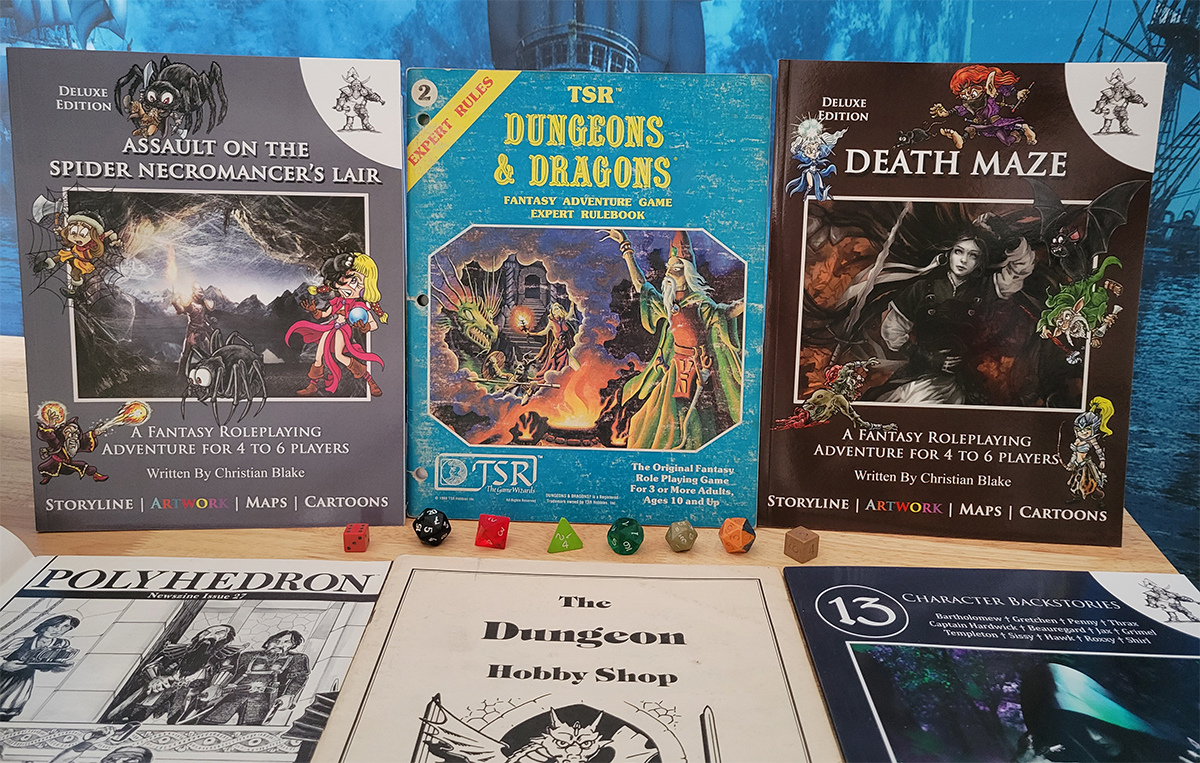
Dungeons and Dragons Fantasy Adventure Game Expert Rulebook
8.5” x 11” paperback, 64 pages
Edition reviewed: First printing, January 1981
The Expert edition rulebook is a continuation of the Basic rulebook. Characters can now advance up to the 14th level. This book discusses more complex situations as well as wilderness adventures. On the second page of the book are several reference charts from the Basic edition.
Similar to the Basic edition, this book is broken down into sections:
Part 1: Introduction
Part 2: Player Character Information
Part 3: Spells
Part 4: The Adventure
Part 5: The Encounter
Part 6: Monsters
Part 7: Treasure
Part 8: Dungeon Master Information
Part 9: Special Adventures
Part 1: Introduction
This section is only two pages. It’s mostly a recap of the Basic edition with a few additional topics.
Standard terms used in this book:
Wilderness – the Expert edition is focused mostly on wilderness settings
Name Level – when characters reach 9th level, they reach Name Level
Castle – a fortified structure that human characters who have achieved Name Level can build for protection
Hideout - a fortified structure that human characters (thieves only) who have achieved Name Level can build for protection
Stronghold – a fortified structure that demi-human characters who have achieved Name Level can build for protection
Reversed Spells – magic users have the option of casting Reversed Spells that will produce the opposite effect listed for a spell. Reversible spells are noted by an asterisk (*).
Magical Research – the spell used by magic users to create a magical item or to possibly create new spells known by no one else.
The last page of the Introduction discusses changes from the early Basic editions to the more recently published editions. Clarifications are made on Alignment, Encumbrance, Weapons, Monsters, Treasure and Magic Items. Cursed items are discussed briefly, and the obsession characters will have toward cursed items in their possession.
Part 2: Player Character Information
Expanded charts are provided for Clerics, Dwarves, Elves, Fighters, Magic-users, Halflings, Thieves and Thieves’ Abilities. Each character class is expanded upon (albeit slightly).
A Weapons and Equipment chart comes next, followed by a detailed description of the items in the Weapons and Equipment chart.
Part 3: Spells
This section starts with explanations on casting restrictions, re-memorizing spells, replacing lost spellbooks and acquiring new spells. Reversed Cleric spells are also discussed as well as Reversed Magic-User and Elf spells.
An interesting paragraph discusses Spell “Stacking”. Obviously, some player at some time cast Haste multiple times on another character and expected cumulative effects. Essentially, stacking is allowed when produced by different sources such as a +2 To Hit Sword, the spell Bless, and a ring that provides +1 To Hit. In such a situation, all three elements would increase the players To Hit chance whereas casting Bless three times upon the same character would only produce beneficial effects from the first spell and nothing from the second and third.
The next section provides 106 new spells for characters.
Part 4: The Adventure
The first couple pages of this section discuss party organization, mapping and movement, including water and air travel. There’s also a section on characters becoming lost.
Specialists and Mercenaries are discussed next. Detailed descriptions as well as monthly salaries are provided for: Alchemists, Armorers, Animal Trainers, Engineers, Sages, Seaman, Spies and Mercenaries which are further broken down into 12 different troop types.
Part 5: The Encounter
The beginning of this section appears to be mostly a recap of the Basic edition with further clarification on Time and Distance in Encounters, Surprise, Initiative, Monster Reactions (chart provided) Evasion and Pursuit. Combat is discussed next for several pages. Combat sequence is explained in-depth, as well as Defensive Movement.
Saving Throws are also discussed and includes a rather large chart for required save rolls against a number of different spells.
A nice, simple chart is provided for Weapon Damage. The next section discusses attacks made without traditional weapons such as: unarmed combat, oil, holy water, lances, mass land combat, aerial and naval warfare.
The next section of The Encounter discusses character Morale (about a ½ page worth of material).
And the final closing items are To Hit charts for both characters and monsters.
Part 6: Monsters
Basic elements of monsters are discussed (hit dice, armor class, etc.) Additional explanation is provided for special attacks such as Charge, Continuous Damage, Energy Drain, Swallow, Swoop and Trample. The bulk of Part 6 is new monsters, and there are about 75 of them (Including sub-types).
Part 7: Treasure
This section provides a very nice set of charts for magic items and is followed by descriptions of each. Two pages of material are dedicated to Intelligent Swords. This is a really nice section that goes into detail about magic swords, and how to “roll up” the abilities associated with an intelligent sword. This includes a list of potential extraordinary powers, languages spoken, and whether or not a sword has a special purpose (such as Dragon Slaying). Rings, potions, scrolls, wands, staves and rods are discussed next. These are not general descriptions but rather a list of specific magic items such as a Staff of Withering or a Control Plant ring. There is a also a list of 18 miscellaneous (but specific) magic items.
Part 8: Dungeon Master Information
This section discusses Magical Research and Production in depth as well as Castles, Strongholds and Hideouts (for Thieves only). Cost details are also provided for individual castle sections such as stairs, gatehouse and dungeon corridors.
The next sections are: Designing a Dungeon, Designing a Wilderness, Wandering Monsters, and Wilderness Encounters. Each section includes a variety of useful charts as well as detailed explanations. A page is devoted to the care and handling of players. And finally, at the end of the section, there is a realm called The Grand Duchy of Karameikos. A large, hexagon terrain map is included as well as a small dungeon map.
Part 9: Special Adventures
This two-page section should have been named Waterborne Adventures as it only discusses water travel, various ship types and their matching crews, ship combat and weather. As I suggested with the Basic edition, this book is a must-have for any serious collector. They are readily available for purchase on auction sites at relatively inexpensive prices, and they are the closest a collector will get to the beginning of Dungeons and Dragons.
One thing to note that is mentioned in the beginning of the book is the early Basic editions had a blue cover as well as a different layout. If you noticed, my Basic edition’s cover is actually reddish orange. So, if you find a Basic edition with a blue cover for sale, it’s definitely more valuable than the Basic editions that were published years later that had the reddish-orange cover.
--------------------------------------------------------------------------
Privacy Policy | Disclaimer | Contact
Dungeons & Dragons, Advanced D&D, AD&D, and D&D are trademarks owned by Wizards of the Coast.